|
| Madonna on tour in 1987 |
 |
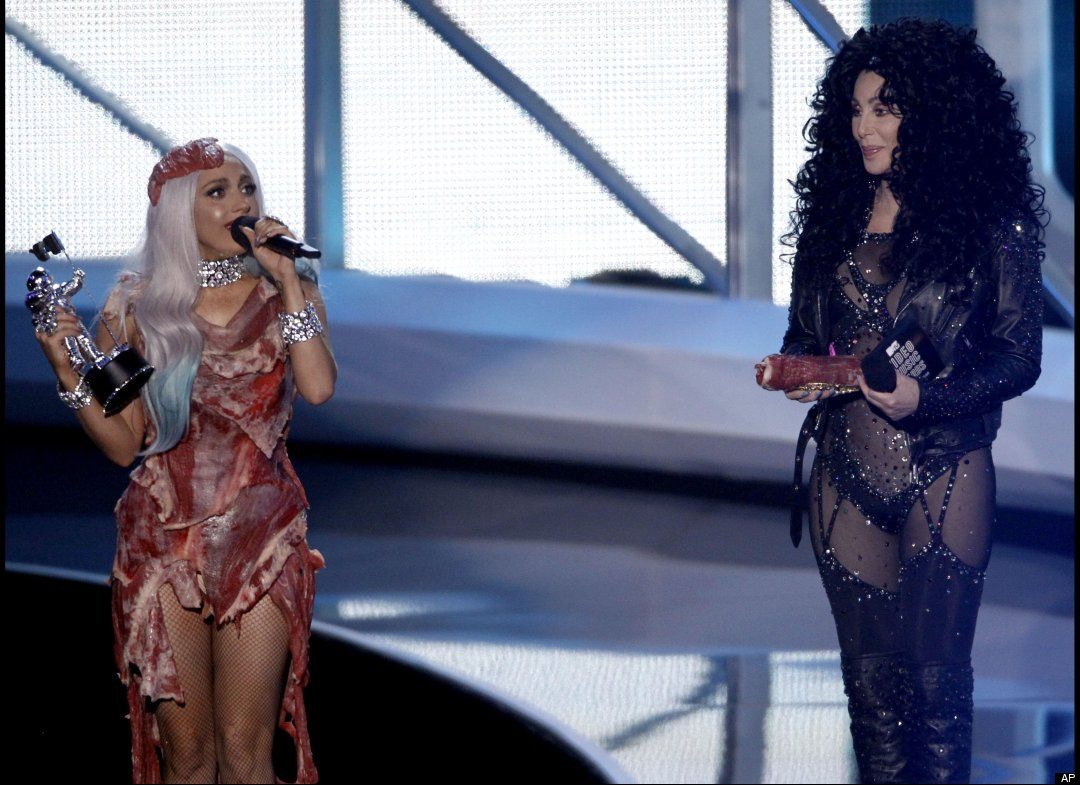
| Cher and Lady Gaga in their most notorious outfits at the 2010 MTV Awards |
Oscar Wilde, Irish poet, author and playwright, once remarked – The only thing worse than being talked about is not being talked about.
The entertainment industry is an industry like any other, and thus the pressure is on celebrities to be more shocking, more outrageous, in order to increase ‘product awareness’ in the market.
As Jenny notes in her post, Applying critical interpretations to Reality TV, marketers are taking advantage of the widespread appeal of ‘reality TV’ and adopting new ploys to reach a wider audience.The growing phenomenon of cross-promotional appearances has resulted in ‘reality TV’ shows, classified for family viewing, increasingly featuring scantily clad music artists gyrating suggestively, eagerly watched by a young and impressionable audience. Inevitably, complaints ensue. There is ‘public outrage’. TV and music producers depend on it.
One of the unfortunate side effects of ‘moral panics’ is that they frequently tend to ensure that ‘offensive’ material reaches an even larger audience, as this recent article in British newspaper The Daily Mail, demonstrates. The article purports to be a serious news story about stricter broadcasting guidelines being implemented in Britain, following a large number of complaints about the ‘inappropriate’ costumes and choreography of guest performers on the X Factor’s final show of the season, aired in December 2010.
However, as Brendan Behan, paraphrasing Wilde, succinctly states – There is no such thing as bad publicity. The article manages to simultaneously adopt a tone of moral outrage while gratuitously including multiple “graphic” images of the offending performances, thereby providing the artists with the kind of coverage publicists dream about.
While Thompson (2010, p397) argues that “sexualised behaviour is generally considered appropriate for adults (assuming it is expressed in socially acceptable ways)”, I question whether the sexualised behaviour exhibited in popular media would be considered ‘socially acceptable’ if displayed in other contexts or by adults other than celebrities.
Images
Cher and Lady Gaga. Retrieved from
Madonna. Retrieved from
References
Thomas, L. (2011) At last... Rihanna and Co told 'you'll have to cover up if you want to appear on X Factor', as Ofcom cracks down on the sexualisation of children. The Daily Mail. 1st October 2011. Retrieved from http://www.dailymail.co.uk/tvshowbiz/article-2043762/X-Factor-Acts-like-Rihanna-Christina-Aguilera-told-cover-Ofcom.html
Kirrilly Thompson (2010): Because looks can be deceiving: media alarm and the
sexualisation of childhood – do we know what we mean?, Journal of Gender Studies, 19:4, 395-400. http://dx.doi.org/10.1080/09589236.2010.533492