Showing posts with label Sexualisation of children. Show all posts

28 Oct 2011

X Rated X Factor


Madonna on tour in 1987
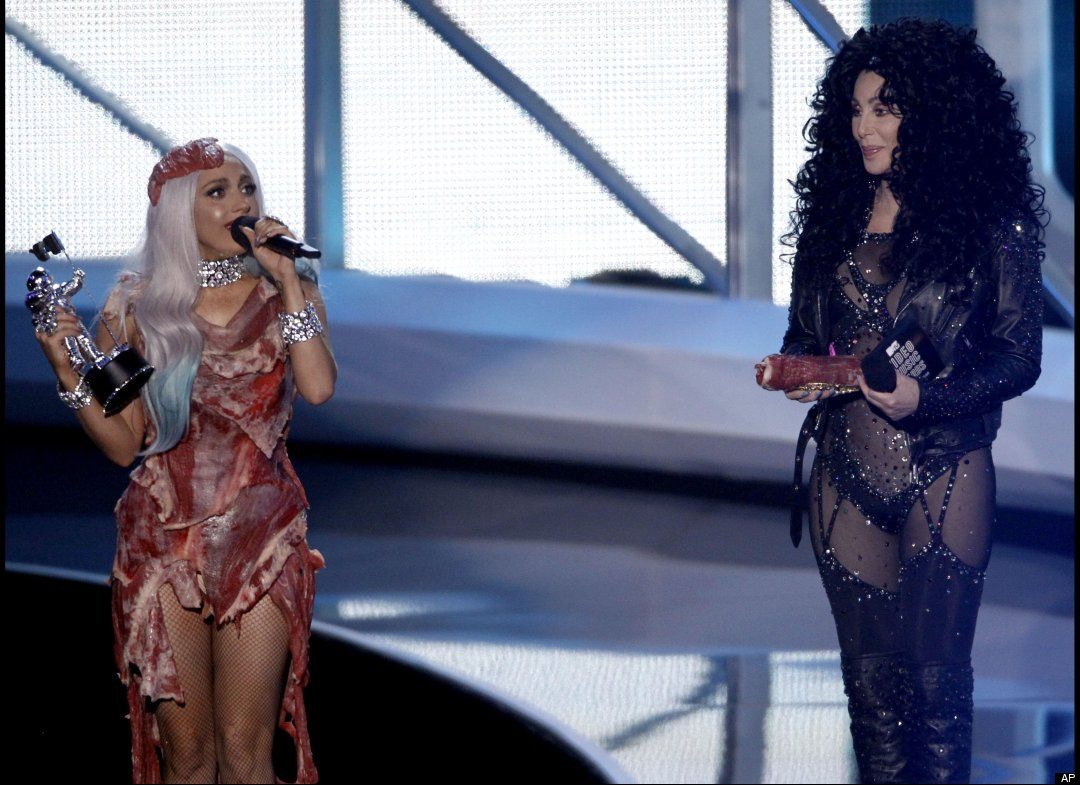
Cher and Lady Gaga in their most notorious outfits at the 2010 MTV Awards
Oscar Wilde, Irish poet, author and playwright, once remarked – The only thing worse than being talked about is not being talked about.  

The entertainment industry is an industry like any other, and thus the pressure is on celebrities to be more shocking, more outrageous, in order to increase ‘product awareness’ in the market.   

As Jenny notes in her post, Applying critical interpretations to Reality TV, marketers are taking advantage of the widespread appeal of ‘reality TV’ and adopting new ploys to reach a wider audience.The growing phenomenon of cross-promotional appearances has resulted in ‘reality TV’ shows, classified for family viewing, increasingly featuring scantily clad music artists gyrating suggestively, eagerly watched by a young and impressionable audience.  Inevitably, complaints ensue.  There is ‘public outrage’.  TV and music producers depend on it.  

One of the unfortunate side effects of ‘moral panics’ is that they frequently tend to ensure that ‘offensive’ material reaches an even larger audience, as this recent article in British newspaper The Daily Mail, demonstrates.  The article purports to be a serious news story about stricter broadcasting guidelines being implemented in Britain, following a large number of complaints about the ‘inappropriate’ costumes and choreography of guest performers on the X Factor’s final show of the season, aired in December 2010.  

However, as Brendan Behan, paraphrasing Wilde, succinctly states – There is no such thing as bad publicity.  The article manages to simultaneously adopt a tone of moral outrage while gratuitously including multiple “graphic” images of the offending performances, thereby providing the artists with the kind of coverage publicists dream about.  

While Thompson (2010, p397) argues that “sexualised behaviour is generally considered appropriate for adults (assuming it is expressed in socially acceptable ways)”, I question whether the sexualised behaviour exhibited in popular media would be considered ‘socially acceptable’ if displayed in other contexts or by adults other than celebrities.  


Images 
Cher and Lady Gaga. Retrieved from 

Madonna. Retrieved from  


References
Thomas, L. (2011) At last... Rihanna and Co told 'you'll have to cover up if you want to appear on X Factor', as Ofcom cracks down on the sexualisation of children. The Daily Mail. 1st October 2011. Retrieved from http://www.dailymail.co.uk/tvshowbiz/article-2043762/X-Factor-Acts-like-Rihanna-Christina-Aguilera-told-cover-Ofcom.html

Kirrilly Thompson (2010): Because looks can be deceiving: media alarm and the
sexualisation of childhood – do we know what we mean?, Journal of Gender Studies, 19:4, 395-400. http://dx.doi.org/10.1080/09589236.2010.533492


23 Oct 2011

The myth of innocence

In an earlier post, I presented a YouTube clip of very young girls performing a dance routine based on the Beyonce hit music video, Single Ladies. Thinking back on my observations, I wondered why I found the clip so disturbing.  A number of recent articles – The innocence fetish (Faulkner, 2010), Too much? too young?  (Lumby and Albury, 2010) and Troubling childhood innocence (Taylor, 2010) – provided me with some insight. 

One of the key points made by Faulkner (2010, p107) is that perceptions of children as sexual beings are determined by the adult gaze.  In other words, sexualisation is a result of viewer interpretation. It seems that not only beauty is in the eye of the beholder, so too is desire.  As Lumby and Albury (2010, p145)  point out, paedophiles can construe a “sexual invitation” in an image of a child regardless of what they are wearing. However, they state that most “reasonable adults [do not view] images of children” in this way (Lumby et. al., 2010, p145).

Yet Taylor (2010, p51) claims that many adults now are doing just that.  Attempts by well-meaning adults to protect children from the potential danger of unwanted sexual attention have created an atmosphere in which all images of children are evaluated from a paedophilic perspective (Taylor, 2010, p51).  Clearly, my own reaction to the YouTube clip has been influenced by the latest ‘moral panic’ concerning the loss of childhood innocence.  

While it may be true that childhood innocence is a social construct (Faulkner, 2010; Lumby et. al., 2010; Taylor, 2010), it is equally true that the moral codes that operate within society are also culturally constructed, and as such, they are subject to change over time; what was once unthinkable, becomes unmentionable, and is ultimately considered unavoidable.


Movie poster for the Baby Burlesks

Few would have considered the images presented by Shirley Temple and her cohort in the Baby Burlesks films to be sexually provocative; they were seen as harmless fun – cute kids playing ‘dress up’.   


Child star -Shirley Temple
 

Although hugely popular in the 1930s, it is unlikely in the current climate that they would even be made at all. 


Shirley Temple in War Babies (1932)  
 One of the major problems in the debate appears to be a reluctance on the part of many adults to recognise that children are in fact sexual beings (Taylor, 2010, p53).  While they might not be sexually mature, they still experience sexual curiosity, desire and pleasure (Taylor, 2010, p53).   Those at the forefront of the ‘moral panic’ have conjured up an alarming picture of hordes of ‘sexually depraved monsters’ ready to pounce on innocent, unsuspecting children if parents relax their guard for even an instant.  Children are seen as 'naturally' innocent. Consequently, a child expressing his or her innate sexuality is immediately presumed to be ‘prematurely sexually aware’.  

If evidence of child sexual abuse is not discovered, then the child’s ‘aberrant’ behaviour is often deemed to be a result of exposure to the ‘inappropriate’ sexualised images presented in popular media such as television.  This in turn results in calls from anxious adults, such as those which prompted the Senate Inquiry into the Sexualisation of Children in Contemporary Media (Standing Committee on Environment, Communications and the Arts, 2008) demanding governments ‘crack down’  on advertisers and broadcasters in order to protect children. 

However, despite widely held fears to the contrary, some researchers claim there is insufficient evidence to demonstrate that exposure to sexualised images actually “encourages [children] to act in adult sexual ways” (Buckingham & Bragg in Lumby et. al., 2010; Lumby et. al., 2010).  In fact, Buckingham and Bragg state that much of the sexual content encountered in popular media is misunderstood by children because they lack the background knowledge required to make meaning from the messages presented (2004 in Lumby et. al., 2010, p147).

Even though many adults would be relieved by this, Faulkner (2010, p107) argues that rather than protecting children, the attempt to perpetuate childhood innocence actually places children at greater risk of harm.  This is echoed by Lumby et. al., (2010, p149) who state “sexual ignorance” is not an effective defence against unsolicited sexual attention.  While much of the ‘moral panic’ focuses on the threat posed by anonymous paedophiles, the ‘stranger danger’ education does little to prepare children and young people to deal with unwanted sexual advances by known adults and peers.   

Kincheloe (2002 in Taylor, 2010, p55-56) points out that attempts by adults and educators to shield children from the ‘inappropriate’ influence of popular media have backfired. In the absence of respectful dialogue between adults and children about sexual issues, children are increasingly turning to popular culture for answers (Taylor, 2010, p56).  While many media producers are, to a degree, bound by industry standards and government imposed regulations, there may be disparity between what is considered acceptable by these agencies, and what is considered acceptable by prevailing cultural standards.   

Given that we live in a consumer-based society, it is unsurprising that manufacturers test the boundaries of what is considered acceptable in order to sell their goods to a wider and wider target audience.

Padded bras for pre-teens
  
Pole dancing doll


Hence, we see advertisements for padded bras designed for prepubescent girls and pole dancing dolls created to appeal to toddlers.


While such products tend to spark community outrage, it must be assumed there is a profitable market for these items; manufacturers habitually undertake considerable market research before committing to the expense of producing and distributing products.

Although this provides an ideal opportunity for parents and other educators to initiate open conversations about children’s “passage to adulthood”, many shy away from broaching the uncomfortable topic of sex, instead bemoaning the circumstances that force them to discuss ‘adult’ subjects with children (Faulkner, 2010, p115-116). Yet clearly, due to the pervasiveness of sexualised imagery in popular media, we cannot prevent children’s exposure to sexualised material. Thus, children may copy the clothing and behaviours of prominent adult figures such as popular media celebrities and be unaware of how they may be perceived by others. 

That being said, it is important for adults to understand that some young people may choose to express their emerging sexuality in ways that adults may consider unsuitable (Lumby et. al., 2010, p149).


Explicit message
Denigrating these outward expressions may actually inhibit the development of a healthy sexual self-image. Nonetheless, it is incumbent on adults to ensure that children are not exposed to age-inappropriate images of sexual relationships, or those that sanction sexually abusive or coercive behaviour (Lumby et. al., 2010, p149).

As stated earlier, visual messages are interpreted by the viewer, and are therefore also open to misinterpretation.  While we cannot control how visual messages are interpreted, it is important for young people’s sexual health and safety that adults and educators help them to develop an awareness of how they could be perceived, understand the possible consequences arising from that and assist them to develop strategies for dealing with risky situations.    


Images

Child star Shirley Temple – retrieved from Daniel, C.L.  (May 2001) Working Boys and Girls:  Using Children in the 1930's.  http://xroads.virginia.edu/~ma01/lundy/childsexual.html
Explicit messages – retrieved from www.truechild.org  http://www.truechild.org/Images/Interior/blog/good%20to%20go.jpg
Padded bras for pre teens – retrieved from www.miraculousladies.com http://www.miraculousladies.com/lifestyle/should-we-sexualise-our-young-daughters/
Pole dancing doll – retrieved from http://gizmodo.com  http://gizmodo.com/5348675/pole-dancer-doll-doesnt-really-set-the-perfect-role-model
Shirley Temple in War Babies (1932) – retrieved from http://denniscooper-theweaklings.blogspot.com/2007/09/kiddiepunk-presents.html

References

Faulkner J. (2010) The innocence fetish: The commodification and sexualisation of children in the media and popular culture. .[electronic version] Media International Australia, Incorporating Culture & Policy. 2010:106-117.  http://www.uq.edu.au/mia/index.html

Lumby C, Albury K. (2010) Too much?: Too young?: The sexualisation of children debate in Australia. [Electronic version] Media International Australia, Incorporating Culture & Policy. May. No 135:141-152.   http://www.uq.edu.au/mia/index.html
Standing Committee on Environment, Communications and the Arts. (2008). Report of the Senate Inquiry into the Sexualisation of Children in Contemporary Media. Canberra: Commonwealth of Australia. Retrieved from: http://www.aph.gov.au/senate/committee/eca_ctte/sexualisation_of_children/report/report.pdf
 . 
Taylor, A. (2010). Troubling childhood innocence: Reframing the debate over the media sexualisation of children. Australasian Journal of Early Childhood. 2010; 35. p48-57. http://www.earlychildhoodaustralia.org.au/australian_journal_of_early_childhood/australian_journal_of_early_childhood.html


15 Oct 2011

Film, Television and Transforming Pedagogy

By Sue

As modern educators, teachers are not only responsible for traditional education – “the 3Rs” – but also to educate the students in topics of the 21st century.  These include media literacies. The internet and mobile media are important, however film and television, as two of the older media continue to be a vital part of most children’s lives.

My major focus in teaching and learning is that I believe learning should be an active process, with inquiry at the centre and the teacher as the facilitator of learning. I employ a constructivist approach to teaching and learning and believe in setting up a problem or a 'quest' and allowing students to construct their own knowledge by connecting from what they know to the new. I act as a facilitator in a majority of cases guiding the learning and allowing students to arrive at their own conclusions. As a social constructivist, I search for the Zone of Proximal Development - find where the students are at and therefore how they can be moved on. I act as a scaffold, providing support for students to achieve. I view learning as a collaborative and a social activity. I attempt to develop knowledge in authentic learning activities, which engage students in the kinds of problems and practices that are present outside of school. These practices must include media of all types as this is what students are using to acquire knowledge and develop socially at home. Therefore it is imperative that I use digital media in the learning context.

My above view of knowledge in the 21st century is supported in a variety of research and current curriculum documents. The Essential Learnings Position Paper (2007) states that knowledge itself has a undergone a transformation.
Knowledge exists in a range of forms, and a comprehensive curriculum will ensure a balance of the most important ones. A synthesis of knowledge typologies illustrates the range which needs to be represented in the curriculum 
(Essential Learnings and Standards Position Paper 2007, p5
My view of the use of digital media in general and film and television in particular is supported by the Melbourne Declaration on Educational Goals for young Australians where it is stated that although technologies are used in schools there is a need to increase the effectiveness of the use of such technologies over the next decade.  (Ministerial Council on Education, Employment, Training and Youth Affairs, 2008) Therefore with the above beliefs in mind it is necessary to approach the media literacies and in particular film and television in a very similar manner, that being not of a passive participant but rather a creator and critical viewer of media.  Jenkins’ White Paper supports this assertation.
“ We are moving away from a world in which some produce and many consume media,
toward one in which everyone has a more active stake in the culture that is produced”  (Jenkins, 2006 P 10)

The 3C’s – Connect, Create and Critical– discussed in the Lecture 11 (QUT, 2011) are an excellent way of allowing students to construct knowledge when using film and television. No longer is it acceptable to just put on a TV show for children to gain knowledge from. I do recall such TV shows as “For the Juniors” where perhaps, sometimes, I would tune in at 1.40pm after second break just to allow my Yr 2 students some down time after play. In that situation I lacked purpose. After many years of teaching this type of activity is no longer acceptable (if it was ever?) It is now necessary to use the medium to connect students to their past knowledge allowing them to construct new learning from it. We can then ensure new   learning is connected through student’s creating with this knowledge. Most importantly, developing the critical aspect of film and television viewing is essential. This view is also supported in the Literacy for the 21st Century Document where the process skills of media literacy are discussed as Access, Analyse, Evaluate and Create.  (Thoman, 2003)

The American Academy of Pediatrics recommends 1-2 hours of screen time per day.  (American Academy of Pediatrics, 2010). This includes film, television, computers, and mobile media. However realistically most children have up to 5 hours of screen time per day not including screen time at school.  So with screen – TV in particular such a major aspect of children’s lives, it is vital that children develop critical media literacy skills. With many children using TV as a background noise in their bedrooms and perhaps just watching to chill out, they may take all that is on ‘the box’ at face value. It is vital for educators to be modelling and practicing the critical viewing of television and movies targeting in particular, the moral panics, gender and ethnicity stereotyping and the sexualisation of children and women. Using TV in education is not just about the what, but rather the how. It is a time when the substantive conversations about important moral issues can take place.  In traditional literacies, teachers constantly discuss comprehension techniques – predicting, questioning, clarifying and synthesising. I consistently apply these known strategies to any film and television viewing. The connections between what is watched and what is read are established.  Television is used not just to support learning – or as a resource, but rather the use of TV and movies is the learning. This targeted use of film and TV resources ensures that, the use of film and television in schools does not become a moral panic in itself. In my community the use of a movie in learning is very rarely seen as an authentic medium – rather parents view this medium as down time and ‘fun’ for the students. This is a view that with publicity is gradually changing.

 I believe digital media is a most powerful medium for providing the optimal opportunity for transformative learning to take place and for students to construct knowledge. It is vital not to simply equip them with knowledge but rather with the skills and processes to access any knowledge they may need in order to achieve success. The appropriate use of film and television in schools assists in transforming learning, developing 21st century skills that will allow students to be productive citizens. Thus film and Television continue to be viable education resources in my setting.

References

American Academy of Pediatrics. (2010). Policy Statement - Media Education. Official Journal of the American Academy of Pediatrics, 1-8.
Australian Curriculum, Assessment and Reporting Authority. (2011, March). Guide to understanding ICSEA. Retrieved April 5, 2011, from My School: http://www.acara.edu.au/verve/_resources/Guide_to_understanding_ICSEA.pdf
Brown, J. (2002). Retrieved October 14, 2011, from Growing Up Digital: How the web changes work, education and the ways people learn.: http://www.usdla.org/html/journal/FEB02_Issue/article01.html
Jenkins, H. C. (2006, August). Confronting the Challenges of Particpatory Culture: Media Education for the 21st Century. . Retrieved October 14, 2011, from http://digitallearning.macfound.org/site/apps/nlnet/content2.aspx?c=enJLKQNlFiG&b=2108773&ct=3017973&notoc=1
Ministerial Council on Education, Employment, Training and Youth Affairs. (2008). Melbourne Declaration on Educational Goals for Young Australians. Retrieved April 4, 2011, from MCEEDYA: http://www.mceetya.edu.au/mceecdya/melbourne_declaration,25979.html
Queensland Studies Authority. (2007). Essential Learnings Position Paper. Retrieved March 30, 2011, from Queensland Studies Authority: http://www.qsa.qld.edu.au/downloads/early_middle/qcar_el_position_paper.pdf
QUT. (2011). Youth, Popular Culture and Texts Blackboard Site - Week 11. Retrieved October 11, 2011, from Youth, Popular Culture and Texts: http://blackboard.qut.edu.au/webapps/portal/frameset.jsp?tab_tab_group_id=_2_1&url=%2Fwebapps%2Fblackboard%2Fexecute%2Flauncher%3Ftype%3DCourse%26id%3D_75617_1%26url%3D
Thoman, E. (2003). Literacy for the 21st Century. London: Center for Media Literacy.

9 Oct 2011

Face the music.

Debate about the possible negative effects of popular music and television on children and young people is not new.  As far back as 1956, there were concerns raised about the appropriateness of permitting Elvis Presley’s  “provocative and sensual movements” (Rosenberg, 2011) to be broadcast.   

In 2008, following a Senate inquiry into the sexualisation of children in contemporary media, the Standing Committee on Environment, Communications and the Arts recommended “ that broadcasters review their classification of music videos specifically with regard to sexualising imagery” (page v, Recommendation 4). 

Yet how effective is classification in protecting children from viewing ‘inappropriate’ music videos? 

A couple of months ago, one of my friends shared this Youtube clip on his Facebook page.


While I was impressed by the girls obvious enthusiasm, energy and flexibility, I was somewhat disturbed by the costumes and the choreography of the routine.  The choreography is clearly based on that in Beyonce’s music video  , and the girls’ movements suggest they themselves are very familiar with the music video.  However, the costumes worn by the girls in this clip are more sexually suggestive than those worn by the performers in the original music video.  As the girls in the clip are only seven years of age, I think it is fairly safe to assume that adults have selected their costumes and choreographed their dance routine. 

The Report of the Senate Inquiry states that preventing children’s exposure to sexual content and imagery is the responsibility of “broadcasters, publishers, advertisers, retailers and manufacturers” (Standing Committee on Environment, Communications and the Arts, 2008, page v, Recommendation One), and that parents and other adult carers of children cannot realistically control their children’s exposure to ‘inappropriate’ material (2008, p 7).

Yet some parents are clearly not concerned about the possible negative consequences of exposing their children to the ‘inappropriate’ images seen in contemporary media, particularly music videos.  In a case of ‘life imitating art’, the early scenes in the following video montage from the American ‘reality’ television show Toddlers and Tiaras, are reminiscent of the final dance scene in the movie Little Miss Sunshine (Dayton & Faris, 2006). 


While parents may not be able to shield their children from exposure to ‘inappropriate’ content in all forms of contemporary media, there is an easy way to restrict the television viewing of young children.  It’s called the ‘off’ button. 


References

beyonceVEVO. (2009). Single Ladies (Put A Ring On It). [video file] Retrieved from http://www.youtube.com/watch?v=4m1EFMoRFvY

Dayton, J., & Faris, V. (Directors). (2006). Little Miss Sunshine [Motion Picture].

Rosenberg, J. (2011). 1956 - Elvis Gyrates on Ed Sullivan's Show. Retrieved from About.com Guide: http://history1900s.about.com/od/1950s/qt/elvissullivan.htm

Standing Committee on Environment, Communications and the Arts. (2008). Report of the Senate Inquiry into the Sexualisation of Children in Contemporary Media. Canberra: Commonwealth of Australia. Retrieved from: http://www.aph.gov.au/senate/committee/eca_ctte/sexualisation_of_children/report/report.pdf
 

TheEdSullivanShow. (2010). Elvis Presley "Hound Dog" on The Ed Sullivan Show [video file]. Retrieved from: http://www.youtube.com/watch?v=rOvUdZgl7vo  

TLC. (2011). Toddlers & Tiaras - Most Outrageous Outfits [video file] Retrieved from http://www.youtube.com/watch?v=ZSl0OGmbmpQ&feature=related

YourDanceChannel. (2010). Single Ladies Dance (7 years old- Original). [video file] Retrieved   from: http://www.youtube.com/watch?v=ir8BO4-7DkM